New Elastic Stack features and solutions expand Elastic’s data
management capabilities and make it easier for users to consume and
express their real-time data
MOUNTAIN VIEW, Calif.--(BUSINESS WIRE)--
Elastic N.V. (NYSE: ESTC), the company behind Elasticsearch and the
Elastic Stack, announced the general availability of version 6.7 of the
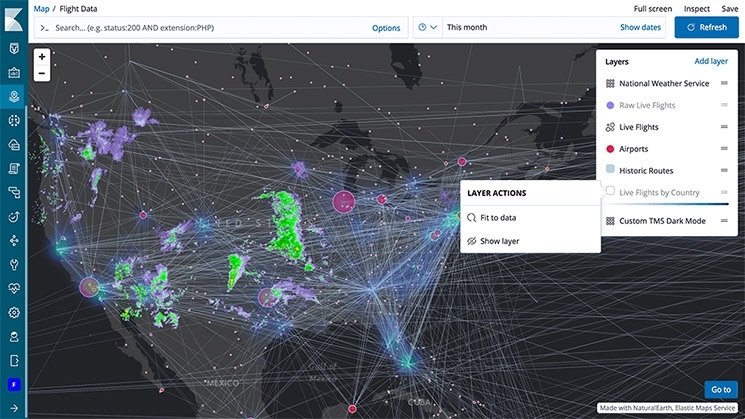
Elastic Stack. This release delivers two new solutions: Maps, for
advanced, layered visualization of geospatial data on a map in Kibana,
and Uptime, a new way to monitor system and service uptime with
Elasticsearch and Kibana. Elasticsearch 6.7 also introduces the
production-ready versions of many features, including cross-cluster
replication, index lifecycle management, Elasticsearch SQL (including
ODBC and JDBC clients), Canvas, and Functionbeat. Elastic Stack version
6.7 is available on Elasticsearch
Service on Elastic Cloud, or users can download
it for self-managed workloads.
This press release features multimedia. View the full release here:
https://www.businesswire.com/news/home/20190326005906/en/
(Graphic: Business Wire)
Elastic Maps Brings New Layers to Geospatial Analytics in Kibana
Geo is an important part of search, whether you’re looking at logs to
see where network traffic originates, answering questions like “How many
taxis were available in the Chicago Financial District in the past 5
minutes?” or even correlating the magnitude and geographic reach of an
earthquake with the scope of a network outage.
The Elastic Maps solution allows users to view and explore this location
data in a more intuitive way. With features like multiple layers and
plotting individual data points and shapes, with many options for
customization, this solution improves on Elastic’s existing geospatial
visualizations. Elastic Maps is launching in beta with the 6.7 release,
and is included in Kibana by default, which means it's available today
in Elastic Cloud.
Expanded Observability with the New Uptime Solution
The 6.7 release also introduces a new solution, Uptime, to proactively
monitor systems, services, and APIs for expanded observability. The
Uptime solution automatically detects when application services are down
or are responding slowly, even before those services are called by the
application, and provides proactive notifications.
Based on Heartbeat,
a lightweight data shipper for uptime monitoring, Uptime can be deployed
both inside and outside an organization’s network. It can be used to
understand service uptime and response time characteristics from
multiple network vantage points and to verify that services are
available and returning the correct response codes. By combining the
Uptime solution with logs, metrics, and APM data, users will be able to
bridge data silos and speed up troubleshooting and root cause analysis
across their observability
initiatives.
Several Key Elastic Stack Features, Including SQL and Canvas,
Graduate to GA Status in 6.7
With version 6.7, several popular Elastic Stack features are graduating
to general availability (GA) status, marking them production-ready.
-
Cross-cluster replication (CCR) gives users a self-contained
mechanism to easily and reliably replicate indices from one cluster to
another. Use cases for this popular feature include high
availability/disaster recovery, geo proximity/data locality
(replicating from a central cluster to local clusters so that the data
is closer to the end user), and centralized search and analysis
(replicating data to a central cluster for reporting and analysis
against a single data source).
-
Index lifecycle management (ILM) gives users a streamlined
method to manage how Elasticsearch indices are stored and managed over
time. Proper data management is critical to running a healthy,
performant, and cost-efficient cluster, and this new feature greatly
simplifies automating and operationalizing this important task. The
lifecycle of an index is broken into four phases — hot, warm, cold,
and delete — and users can define policies to control how long an
index lives in each phase, as well as optimize for performance and/or
cost-efficiency as the data ages.
-
Elasticsearch SQL enables customers to use the familiar SQL
syntax to query data in Elasticsearch. The introduction of this
feature opens up the full-text powers, scale, and speed of
Elasticsearch to a much wider audience that may already be well-versed
in the SQL syntax and are just beginning their Elasticsearch journey.
Also going GA are the JDBC and ODBC clients for Elasticsearch, which
will let users connect to an Elasticsearch data backend from
third-party tools that support these drivers.
-
Canvas allows users to create dynamic infographic-style
presentation with their live Elasticsearch data. It elevates the
visual storytelling in Kibana to new heights, opening up your data
analysis and insights to broader audiences. Canvas includes full
support for Elasticsearch SQL, and just like JDBC and ODBC clients, it
lets Elasticsearch users expand the reach and impact of their data to
broader business audiences.
-
Functionbeat is a new kind of Beat that deploys as a function
in serverless computing frameworks, and streams cloud infrastructure
logs and metrics into Elasticsearch. Functionbeat currently supports
the AWS Lambda framework, and can stream data from CloudWatch Logs,
SQS, Kinesis, and API gateways.
-
The Elastic Logs solution provides users with real-time log
tailing in a compact, customizable display. It’s similar to tailing a
file, but with the ability to see the logs from all your
infrastructure in a single streaming view. And with an embedded search
bar powered by Elasticsearch, users can easily narrow the streaming
view to just the logs they are looking for.
-
The Elastic Infrastructure solution gives users a bird’s
eye view of the health of all the components — servers, Kubernetes
pods, Docker containers — in their infrastructure, making it easier to
diagnose problems using log and metrics data. Building on the
autodetect capabilities of Metricbeat, the tailored user interface
allows you to interactively view and drill into the logs, metrics, and
APM traces with a single click.
Learn More
About Elastic
Elastic is a search company. As the creators of the Elastic Stack
(Elasticsearch, Kibana, Beats, and Logstash), Elastic builds
self-managed and SaaS offerings that make data usable in real time and
at scale for search, logging, security, and analytics use cases.
Elastic and associated marks are trademarks or registered
trademarks of Elastic N.V. and its subsidiaries. All other company and
product names may be trademarks of their respective owners.

View source version on businesswire.com: https://www.businesswire.com/news/home/20190326005906/en/
Deborah Wiltshire
Elastic
press@elastic.co
Source: Elastic N.V.