Elasticsearch 6.7 enables cross-datacenter replication,
geographically located data, and customizable data replication strategies
MOUNTAIN VIEW, Calif.--(BUSINESS WIRE)--
Elastic N.V. (NYSE: ESTC), the company behind Elasticsearch and the
Elastic Stack, announced the general availability of cross-cluster
replication (CCR) in version 6.7 of the Elastic Stack. CCR enables
native replication of data between Elasticsearch clusters, whether they
are located in the same datacenter or across the world. Cross-datacenter
replication has been a requirement for mission-critical applications on
the Elastic Stack and was previously solved with additional
technologies. With the latest release of the Elastic Stack, no
additional technologies are needed to replicate data across datacenters,
geographies, or Elasticsearch clusters.
This press release features multimedia. View the full release here:
https://www.businesswire.com/news/home/20190404005723/en/
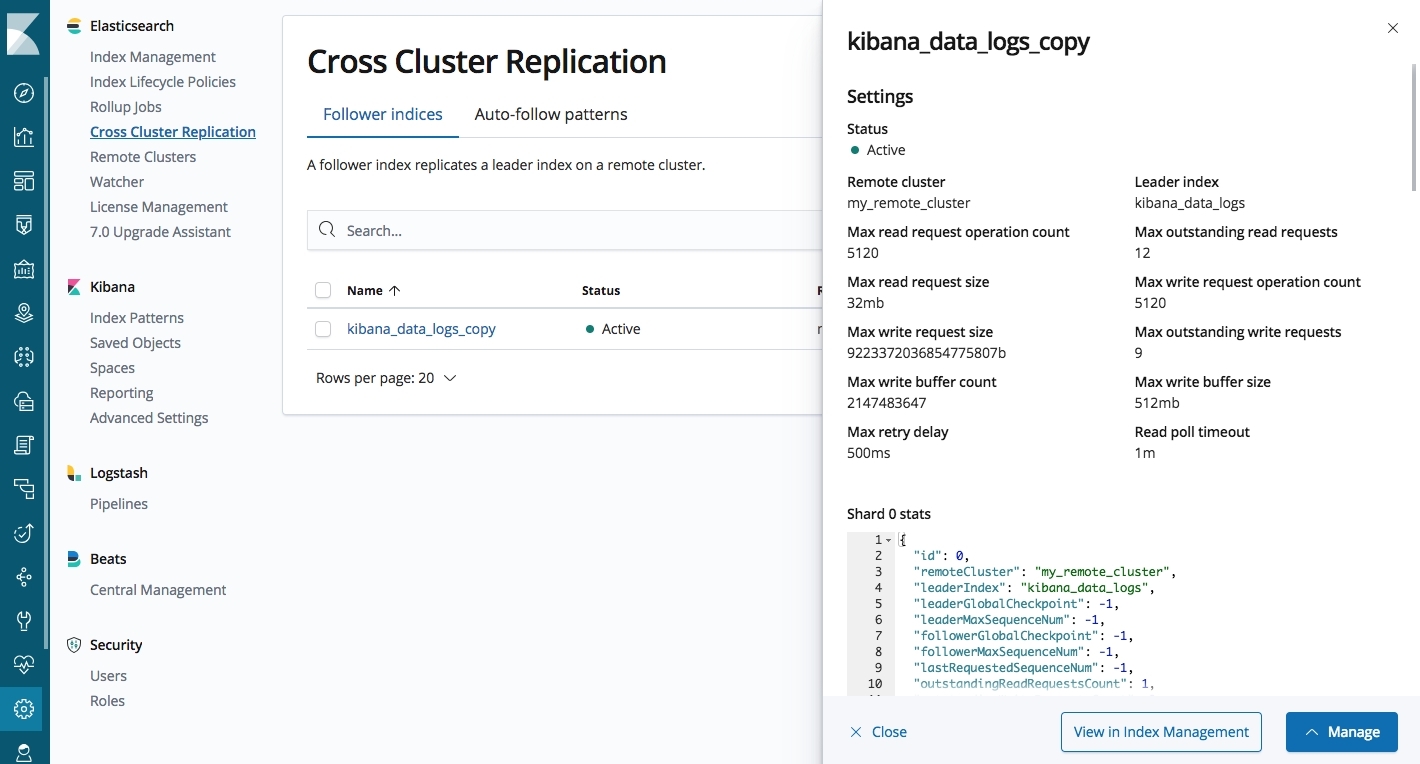
Elasticsearch CCR Management UI in Kibana (Graphic: Business Wire)
"Cross-cluster replication in Elasticsearch has been the most asked-for
feature by our customers, who have been putting more and more
business-critical data into their Elasticsearch clusters,” said Shay
Banon, founder and CEO of Elastic. “Built-in cross-cluster replication
helps solve for disaster recovery, geo data locality, and centralized
data location. It is a critical step in Elasticsearch’s evolution as a
data store.“
The native cross-cluster replication feature is efficient, scalable, and
reliable and enables a variety of mission-critical use cases for
Elasticsearch and the Elastic Stack.
-
Disaster recovery (DR) / high availability (HA): Tolerance to
withstand a datacenter or region outage has become a requirement for
many mission-critical applications. Replicating data across
Elasticsearch clusters ensures that if a cluster is unavailable due to
a datacenter or infrastructure outage, one or more copies of the data
are available in additional locations to ensure business continuity.
-
Data locality / geo-proximity: CCR can be used to
replicate data from a central location to geographically distributed
locations to maintain copies of data that are closer to end users. For
example, a product catalog or reference dataset may be replicated to
20 or more datacenters around the world to minimize the distance
between the data and the end user. Another example of geographically
replicating data may be a stock trading firm with offices in London
and New York. All trades in the London office are written locally and
replicated to the New York office, and all trades in the New York
office are written locally and replicated to London. Both offices then
have a global view of all trades.
-
Centralized reporting: Replicating data from a large number of
dispersed clusters back to a centralized reporting cluster is another
valuable use case for CCR. This is useful when it may not be efficient
to send cross-cluster queries across a large network. For example, a
large global bank may have 100 Elasticsearch clusters around the
world, each within a different bank branch. CCR can be used to
replicate events from all 100 banks around the world back to a central
cluster where they can be analyzed and aggregated locally.
Prior to Elasticsearch 6.7.0, these use cases could be partially
addressed with third-party technologies. These technologies were
cumbersome, carried a lot of administration overhead, and had
significant drawbacks. With CCR natively integrated into Elasticsearch,
users are freed of the burden and drawbacks of managing complicated
solutions, and also enjoy additional advantages that are not available
in existing workarounds (e.g., comprehensive error handling). CCR
includes both APIs within Elasticsearch and UIs in Kibana for managing
and monitoring replication jobs.
The CCR feature in Elasticsearch is designed and architected with government-grade
security controls at its heart. All replicated data is encrypted in
transit across Elasticsearch clusters, and specific access controls can
be specified at the cluster, index, document, or field level.
Furthermore, CCR bakes in support for centralized authentication
systems, which is a requirement for some organizations.
Replication management and administration are important to ensure
CCR architectures are correctly configured and working as designed.
Elastic has released a robust management and monitoring UI within Kibana
specifically for Elasticsearch CCR. Connections across Elasticsearch
clusters can be configured and monitored and data replication can be
initiated all with a few clicks.
Learn more
About Elastic
Elastic is a search company. As the creators of the Elastic Stack
(Elasticsearch, Kibana, Beats, and Logstash), Elastic builds
self-managed and SaaS offerings that make data usable in real time and
at scale for use cases like application search, site search, enterprise
search, logging, APM, metrics, security, business analytics, and many
more.
Elastic and associated marks are trademarks or registered
trademarks of Elastic N.V. and its subsidiaries. All other company and
product names may be trademarks of their respective owners.

View source version on businesswire.com: https://www.businesswire.com/news/home/20190404005723/en/
Elastic
Deborah Wiltshire
press@elastic.co
Source: Elastic N.V.