Foundational changes improve relevance and speed of Elastic Stack
features and solutions including a new Kibana interface, improved
function scoring, intervals querying, and cluster resiliency
MOUNTAIN VIEW, Calif.--(BUSINESS WIRE)--
Elastic N.V. (NYSE: ESTC), the company behind Elasticsearch and the
Elastic Stack, announced the general availability of version 7.0 of the
Elastic Stack. This release delivers several foundational changes
including big improvements to query speed and relevance with the
introduction of new query types in Elasticsearch, a fully revamped
cluster coordination framework that hardens resiliency, and a completely
redesigned Kibana interface that simplifies the user experience and
navigation. Elastic Stack 7.0 is immediately available for download,
or users can spin up fully managed deployments on the Elasticsearch
Service on Elastic Cloud.
This press release features multimedia. View the full release here:
https://www.businesswire.com/news/home/20190410005740/en/
(Graphic: Business Wire)
Kibana Welcomes a Fresh Design, New Navigation ... and Dark
Mode
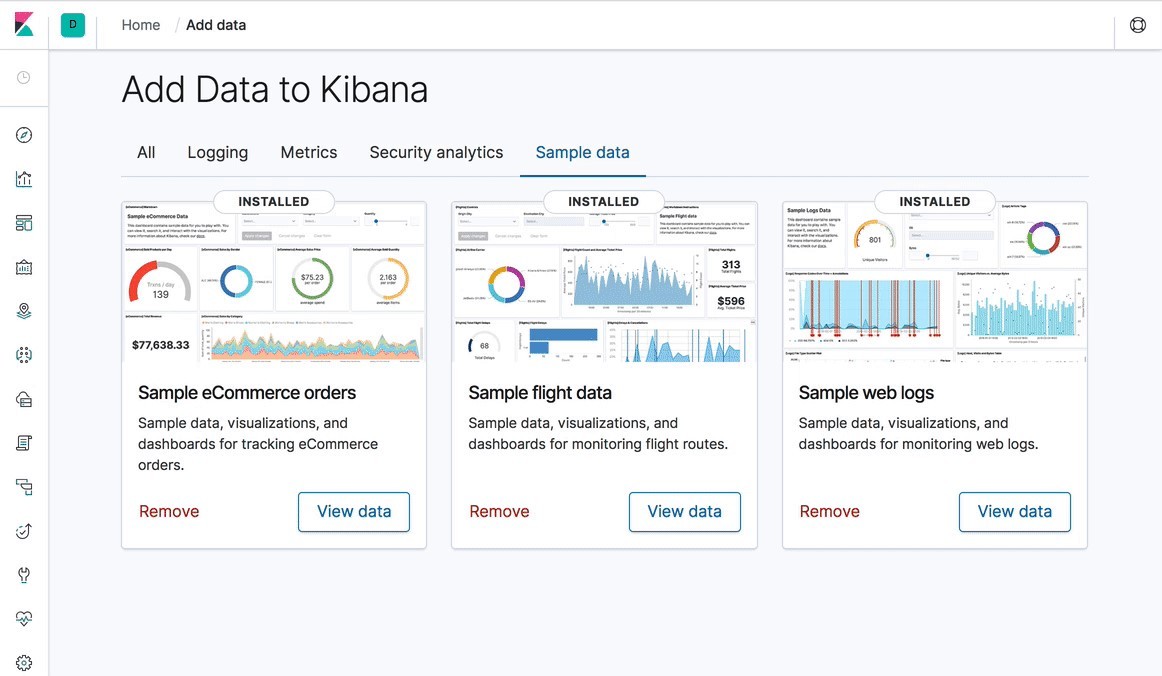
Kibana 7.0 delivers on a fresh user interface that embraces a lighter,
cleaner, and more minimalist design aesthetic. The goal of the redesign
is to put the content and data at the center of the user experience. The
new design builds on months of engineering and design effort on the new Elastic
UI framework, a set of consistent and reusable UI components that
were first introduced in version 6.2. The result is a more uniform and
consistent user experience across all touch points in Kibana. As another
benefit of these changes, Kibana dashboards now have a responsive
design, which is the first step in dramatically improving usability on
mobile devices.
Kibana 7.0 also delivers on a much-requested feature: dark mode for all
of Kibana. Previously, dark mode was limited to Kibana dashboards. By
extending dark mode to all of Kibana, Elastic users that deploy Kibana
in low-light environments, such as NOCs and SOCs, can enjoy an enhanced
visual experience, with better contrast and improved readability of text.
Elasticsearch 7.0 Gives Relevance and Speed a Boost Across Use Cases
Relevance and speed are the cornerstones of most search experiences. And
Elasticsearch 7.0 introduces several foundational features that improve
both.
-
Faster top k queries: In many search use cases, quickly seeing
the top k (say 20) results on a query matters much more to the user
than the exact hit count (i.e., total number of results matching the
query). For example, if someone is searching for a product on an
e-commerce website, they are much more interested in the 10 most
relevant results than the other 120,897 results that matched their
search query. Elasticsearch 7.0 (and Lucene 8.0) implements a new
algorithm (Block-Max WAND) that provides a huge speed boost when
retrieving top hits.
-
Intervals queries: Some search use cases, such as legal and
patent search, introduce the need to find records in which words or
phrases are within a certain distance from each other. Intervals
queries in Elasticsearch 7.0 introduce a brand new way of structuring
such queries and are significantly simpler to use and define compared
to the previous methods (span queries). Intervals queries are also
much more resilient to edge cases compared to span queries.
-
Function score 2.0: Custom scoring is the bread and butter of
advanced search use cases, where one wants finer control over
relevancy and results ranking. Elasticsearch has provided the ability
to do this since its early days. 7.0 introduces the next generation of
function score capability, providing a simpler, modular, and more
flexible way to generate a ranking score per record. The new modular
structure allows users to mix and match a set of arithmetic and
distance functions to construct arbitrary function score calculations,
giving them more control over how results are scored and ranked.
A New Era for Cluster Coordination Hardens Resiliency
Scale and resiliency have been central themes in Elasticsearch since the
very beginning. The cluster coordination layer, called Zen Discovery,
has been a key component of that resilient design.
With Elasticsearch 7.0, Elastic
has completely rebuilt this cluster coordination layer to be faster,
safer, and easier to use. 7.0 also includes a number of changes that
reduce the likelihood of human error and provide clearer choices when
recovering from catastrophic failures. The ground-up rebuild of the
cluster coordination layer was a huge accomplishment — it’s not easy to
improve reliability, performance, and user experience all at once,
especially in such a central component. Most importantly, the new
cluster coordination layer provides strong building blocks for the
future of Elasticsearch, ensuring that Elastic can build functionality
for even more advanced use cases to come.
Another improvement to resiliency in 7.0 is the introduction of the real
memory circuit breaker, which much more accurately detects unserviceable
requests made to a node and prevents them from making an individual node
unstable. This change significantly improves the overall node and
cluster reliability.
Smoother Zoom in Elastic Maps with Geotile Grid
Geo is an integral part of most search experiences, and it has been an
area of constant engineering investment for Elastic. Elastic added support
for ingesting and querying geo data in very early versions of
Elasticsearch, and then recently moved geo_point and geo_shapes to
Bkd-backed storage structures, with significant storage and query
performance improvements (in some cases by 25x). On the visual
exploration end, the introduction of Elastic Maps in version 6.7
provided a dramatically improved way to visually map, explore, and query
location data.
With 7.0, the evolution of the geo story in the Elastic Stack continues
with the addition of a new geotile_grid aggregation in Elasticsearch to
handle (geo) map tiles in a way that allows a user to zoom in and out on
the map without altering the shape of the result data. Elastic Maps in
7.0 is already using this new aggregation. Prior to this change, the
fringes of the shape could slightly change with the change in the zoom
level because the rectangular tiles would change orientation at
different zoom levels. This level of accuracy is important, whether the
user is protecting a network from attackers, investigating slow
application response times in specific locations, or tracking a relative hiking
the Pacific Crest Trail.
Strengthening Time Series Use Cases with Nanosecond-Precision Support
Whether it’s infrastructure metrics, system audit logs, network traffic,
or a rover on Mars, time series data is central to how many people use
the Elastic Stack. The ability to precisely order and correlate events
across multiple systems and services is key.
Until now, Elasticsearch only stored timestamps with millisecond
precision. 7.0 adds a few zeroes, bringing this to nanosecond precision,
which gives users with high-frequency data collection needs the
precision required to accurately store and sequence this data. The
change was made possible by migrating from the historical JODA library
to the official Java time API in JDK 8.
Learn More
About Elastic
Elastic is a search company. As the creators of the Elastic Stack
(Elasticsearch, Kibana, Beats, and Logstash), Elastic builds
self-managed and SaaS offerings that make data usable in real time and
at scale for search, logging, security, and analytics use cases.
Elastic and associated marks are trademarks or registered
trademarks of Elastic N.V. and its subsidiaries. All other company and
product names may be trademarks of their respective owners.

View source version on businesswire.com: https://www.businesswire.com/news/home/20190410005740/en/
Elastic
Deborah Wiltshire
press@elastic.co
Source: Elastic N.V.